
Home › Specialities › Vision correction › Eyewear guide › Dispensing vs selling
Dispensing vs selling spectacles: what is the difference?
Selling is handing over a product. Dispensing adds the steps that make spectacles work for your eyes: a frame chosen for your power and daily use, pupil distance and fitting height measured in that frame, lenses checked against the prescription with a lensmeter, then fitted, adjusted on your face and looked after.
A pharmacist does not simply hand over a medicine. He or she reads the doctor's prescription, checks the medicine and the dose against it, and explains how to take it. That is dispensing. Spectacles work the same way. Your prescription is a set of numbers; a pair of spectacles is those numbers placed accurately in front of your eyes, in a frame that fits your face and your day. A pair made without these steps can cause headaches even when the prescription is right.
This page describes the steps of spectacle dispensing in general, so that you know what to expect and what to ask. It is part of our eyewear guide.
What does dispensing optician mean?
A dispensing optician is a person trained to turn a prescription into spectacles: to advise on frames and lenses, take the measurements, check the finished pair and fit it. In some countries, such as the United Kingdom, it is a registered profession of its own. In many places, including India, the same work is often done by optometrists and trained optical staff working alongside the eye doctor.
Step 1: reading the prescription
A spectacle prescription gives numbers for each eye: the sphere (SPH), minus for short sight and plus for long sight; the cylinder (CYL) and axis, for astigmatism; and, after about 40, an addition (ADD) for reading. Before anything is made, the dispenser checks that the prescription is recent, that it is meant for the use you have in mind (distance, reading, computer or all of these), and whether anything needs special care, such as a large difference between the two eyes or a big change from your old pair. Anything unusual is confirmed with whoever tested your eyes before the lenses are made. See how the eye test for glasses produces these numbers.
Step 2: choosing a frame for your power and your day
The frame is chosen around the prescription, not the other way round.
- High minus power (strong short sight): a smaller frame with your eyes near the centre of each lens keeps the thick edges down, and full-rim plastic hides them. Our page on stylish frames for high power explains why.
- High plus power (strong long sight): small, well-centred frames keep the lens centres thinner and lighter.
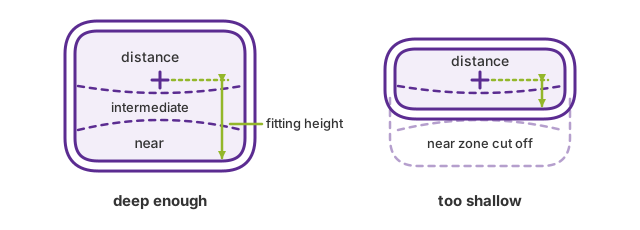
- Progressive or bifocal lenses: the frame must be deep enough for the reading zone, usually about 30 mm or more; see frames for progressive lenses.
- Driving: a wide distance view and arms that do not block your side vision.
- Reading and screens: the working distance decides the lens type: single-vision reading, office or progressive lenses.
- Children and rough use: flexible frames, spring hinges and impact-resistant lenses.
Step 3: measuring with the chosen frame on
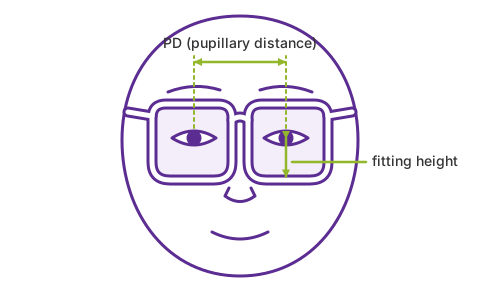
Measurements are taken with your chosen frame adjusted on your face, because every frame sits at a slightly different height and distance from your eyes.
Pupillary distance (PD)
The PD is the distance between the centres of your pupils, in millimetres; most adults measure somewhere between about 54 and 74 mm. Faces are rarely perfectly symmetrical, so it is measured for each eye separately, from the centre of the bridge of your nose (the monocular PD). The near PD is a few millimetres smaller, because your eyes turn in slightly to read.
Fitting height
This is the height of your pupil above the bottom of the lens opening, measured with the frame on. For progressive lenses the fitting point is placed at the centre of the pupil, which positions the distance, middle and reading zones. For bifocals, the top of the reading segment usually sits at the edge of your lower eyelid. For single-vision lenses, the optical centre is placed close to pupil height, usually a little lower to match the tilt of the frame.
Why the centres matter
Away from its optical centre, every lens bends light slightly sideways, like a weak prism, and shifts what you see. The effect grows with the power and with the error. For example, with a lens of 5 dioptres, a centre placed 2 mm out of line gives about one prism dioptre of unwanted prism. Your eyes can cope with a little sideways prism, but much less with a difference in height between the two eyes, which can cause strain, headaches or double images.
Step 4: frame tilt, wrap and back-vertex distance
- Tilt (pantoscopic tilt): the lower rim of most frames tilts slightly towards your cheeks, so the lens stays at a similar angle to your eye when you glance down.
- Wrap (face-form angle): how much the front curves around your face. Strong wrap needs a lens design that corrects for it.
- Back-vertex distance: the gap between the back of the lens and the front of your eye. For powers above about 4 dioptres, a few millimetres' difference changes the effect of the lens, so it is measured and the lens power can be adjusted to match.
Personalised progressive lenses are made using these numbers, so that they work in the position where they will actually sit.
Step 5: choosing lens material and coatings
- Standard plastic: suits most low and moderate powers.
- Polycarbonate and other impact-resistant materials: resist impact, so they suit children, sport and rimless frames.
- High-index plastic: makes strong powers thinner and lighter.
- Glass: resists scratches well but is heavy and can shatter, so it is used less often now.
- Coatings: a hard coat against scratches; an anti-reflection coat for fewer reflections; and water- and smudge-repellent layers. Photochromic lenses darken in UV light but stay fairly light inside a car, because the windscreen blocks UV. Blue-light filtering lenses are a comfort choice: a 2023 Cochrane review found no clear evidence that they reduce digital eye strain.
More detail is in types of spectacle lenses.
Step 6: checking the finished lenses
When the lenses come back from the lens maker, they are checked before you see them. A lensmeter, also called a focimeter, measures each lens: sphere, cylinder, axis, prism and reading addition. It also marks the optical centre, so that its position can be compared with your PD and fitting height. Progressive lenses carry tiny permanent engravings that let the dispenser find the fitting point again after the temporary ink markings are wiped off. They are also checked for scratches, coating faults and a firm fit in the frame. The international standard for mounted spectacle lenses (ISO 21987) sets the small differences that are allowed.
Step 7: fitting and adjusting on your face
The finished pair is then fitted to you. The frame is adjusted so that it sits level with both lenses at the right height; the nose pads rest evenly; the arms reach your ears and curve down gently behind them; the tilt and the distance from your eyes match the measurements; and your eyelashes do not brush the lenses. You then look at far, middle and near targets with both eyes. With progressive lenses you are shown how to use them: point your nose at what you want to see, and lower your eyes, not your head, to read.
Step 8: aftercare
Frames loosen with heat, sweat and daily handling, so small adjustments and screw checks are part of dispensing. Go back to whoever made your spectacles if:
- headaches, eye strain or a pulling feeling do not settle within a few days, or within about two weeks for progressive lenses;
- you see double, or one eye feels different from the other;
- the floor still looks tilted or curved, or steps seem nearer or farther than they are, after the first few days;
- the frame slips, pinches or sits crooked.
The cause may be a measurement, an adjustment or a power that needs rechecking. Sudden blurring, flashes of light, a curtain over your vision, pain or a red eye are not spectacle problems: see the eye doctor the same day. Your eye doctor or optometrist will also advise when to recheck your eyes and change your spectacles.
What can go wrong when a step is skipped?
When one of these steps is missed, these problems can follow, and they may be blamed on the eyes or the prescription instead of on the pair:
- Wrong optical centres: unwanted prism, causing eye strain, headaches or double images, worse with strong powers.
- Progressive zones in the wrong place: you tilt your chin up to read, turn your head to find a clear spot, or find the reading area too small. Some people then decide that progressive lenses do not suit them, when the fit was the problem.
- A frame too big for a high power: thick, heavy edges, spectacles that slide down the nose, and blur and distortion away from the centre.
- Vertex distance ignored with a strong power: the lenses feel too strong or too weak, even though the prescription is right.
- Ready-made readers used for everything: they have the same power in both eyes, a standard PD and no correction for astigmatism. They can be enough for short reading tasks for some people over 40, but not for unequal eyes or astigmatism.
- No final check: a mistake by the lens maker reaches your eyes instead of being caught on the lensmeter.
Dispensing in one line
Good dispensing follows a simple sequence: the eye test first; then a frame chosen around your prescription, your measurements and the way you use your eyes; then lenses made, checked and fitted, with follow-up when you need it. Fit and lenses matter more than the label on the frame.
If you need spectacles, the Vision Correction Centre at ReNew Vision Eye Hospital, Vasco, provides vision correction: an eye test, lenses made to your prescription, and help choosing a frame that suits your lenses and your face.
Questions patients ask
Why is my PD measured with the frame on?
Your PD does not change with the frame, but the fitting height and the position of each lens centre do. Every frame sits at a slightly different height and distance from your eyes, so the measurements, especially for progressive and bifocal lenses, are taken in the frame you have chosen after it has been adjusted to your face.
Can I use the PD from an old prescription or an old pair?
It is a useful starting point for single-vision lenses, but it is not enough on its own for progressive or bifocal lenses, which also need a fitting height measured in the new frame. Children's PD changes as they grow, so it should be measured again each time.
What is a lensmeter or focimeter?
It is an instrument that measures the power of a finished spectacle lens: sphere, cylinder, axis, prism and reading addition. It also marks the optical centre. Checking new lenses on it confirms that they match your prescription and measurements before you wear them.
How long does it take to get used to new spectacles?
Usually a few days for single-vision lenses, a little longer after a big change in power, and up to about two weeks for progressive lenses. If headaches, strain, dizziness or double images last beyond that, have the fitting, the measurements and the power checked.
What should I bring when I need new spectacles?
Your latest prescription and your present spectacles, even if they are broken, and a note of how you use your eyes: driving, reading, computer work, sport or a particular job. If you wear a helmet at work or on a two-wheeler, mention it, because it affects the choice of frame arms.
This page is general eye-health information, not personal medical advice. Your eye doctor advises you after examining your eyes.