Home › Specialities › Vision correction › Eyewear guide › Frames for high power
Can I wear stylish frames with a high power?
Yes. With a high power, choose a modest-sized frame in which each pupil sits near the centre of its lens, with a full rim, often in acetate for minus power, and high-index aspheric lenses with an anti-reflection coating. Round and panto shapes keep lenses thinnest. Rimless, half-rim and very large frames show or add thickness.
Many people with strong spectacles believe fashionable frames are not for them. That is not so. With a high power the frame matters more, not less: the same lens can look thin and light in one frame and thick and heavy in another. Knowing why lets you choose a style you like and still see well.
What counts as a high power?
Your prescription is measured in dioptres (D). Minus numbers are for short sight (myopia); plus numbers are for long sight (hypermetropia) and most reading glasses. Eye doctors call short sight of about minus 5 to minus 6 D or more 'high myopia' (the WHO uses minus 5 D; the International Myopia Institute uses minus 6 D). For choosing a frame, powers beyond about 4 D, plus or minus, and strong astigmatism (the cylinder number) already change what works.
High myopia is also a reason for regular eye check-ups. Highly short-sighted eyes have a higher risk of retinal problems, such as a retinal tear or detachment, and of glaucoma. Your eye doctor advises how often your retina should be examined; see eye check-up. Sudden flashes of light, a shower of new floaters or a shadow spreading over your vision need urgent attention.
Why strong lenses look thick
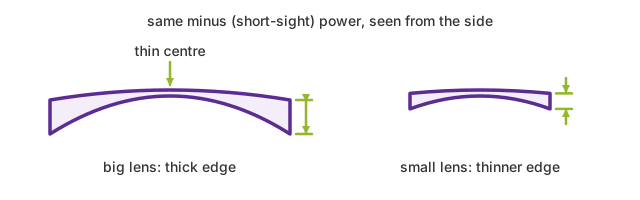
A minus lens is thin in the middle and thick at the edges. A plus lens is the opposite, thick in the centre and thin at the edges. The further the lens edge is from the optical centre, the thicker the minus edge, or the thicker the plus centre, has to be. Three things decide that distance:
- Lens size: a bigger lens opening means a longer distance from the centre to the edge.
- Centring: each lens's optical centre must sit in front of your pupil. If the frame is wide for your face, the centre has to be moved towards the nose, and the outer edge ends up further from it and thicker. Frames whose lens centres are close to your own pupil distance avoid this.
- Shape: corners are the points furthest from the centre, so square and rectangular lenses have the thickest corners with minus power. Round and panto shapes keep the edge more even.
Frame choices for high power, one by one
Round and panto frames
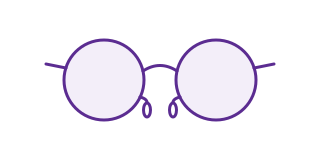
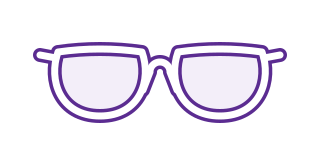
The round frame is a 1920s and 1930s look that keeps coming back; the panto, also called P3, is a round with a flattened upper edge. In a modest size, both keep every point of the lens edge at a similar distance from the centre.
- Advantages: the most even and thinnest edges for a given power; fashionable again; acetate versions hide what edge remains.
- Disadvantages: a small round can look small on a broad face; very small lenses narrow your side view; round shapes can make a round face look rounder.
- Good for: high minus and high plus powers; square and angular faces (round); most faces (panto).
- Think twice if: you have a broad face (reach the width with a wider bridge rather than bigger lenses), or you need progressive lenses in a very small round (check the depth).
Full-rim acetate in other shapes
A thick plastic rim hides the edge of a minus lens. Thick, sculpted acetate appeared in 2026 trade-magazine trend reports such as 20/20's Frame Report, which gives people with strong powers a current look. Acetate, a plastic made from cellulose (the fibre in cotton and wood pulp) mixed with a softener, can be warmed and adjusted; frame materials compares it with metal, titanium and TR90.
- Advantages: hides minus edges and the rings seen at the edge of strong lenses; durable; dark and tortoise colours hide the edge better than clear.
- Disadvantages: heavier than metal, and a heavy lens adds to it; a moulded bridge can slide on a low nose bridge; square and rectangular corners hold the thickest part of a minus lens.
- Good for: moderate to high minus powers; people who want a bold frame.
- Think twice if: you have a low nose bridge without a low-bridge fit or pads, or a very high plus power, where the weight sits in the centre and a lighter frame helps.
Thin metal full-rim frames
Fine wire rims in steel or titanium. Wire frames were everyday spectacles long before plastics; no single designer is credited.
- Advantages: light; adjustable nose pads centre the frame on your pupils and set its distance from your eyes; well matched to plus lenses, whose edges are thin.
- Disadvantages: the thick edge of a strong minus lens sticks out behind a thin rim.
- Good for: high plus powers in a small round or oval frame; anyone who needs a light frame.
- Think twice if: you have a high minus power and dislike visible edges.
Half-rim (supra)
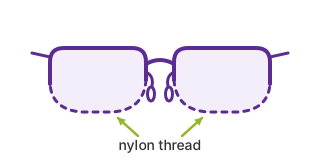
A rim along the upper edge only, with a thin nylon cord sitting in a groove cut around the lower edge of the lens; its inventor is not well documented.
- Advantages: a lighter look; minus lenses have enough edge thickness for the groove.
- Disadvantages: the whole lower edge of a minus lens is on show; a high plus lens has thin edges and may need to be made thicker to take the groove; the cord can loosen.
- Good for: moderate minus powers in an office style.
- Think twice if: you have a high plus power, or a very high minus power and want to hide the edge.
Rimless
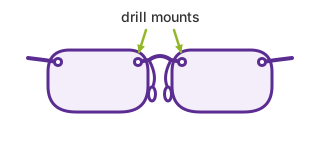
The bridge and arms are fixed through holes drilled in the lenses, with no rim; no single designer is credited with the idea.
- Advantages: the lightest frame; nothing outlines the edge.
- Disadvantages: the full edge is visible from every side; the drill holes sit in the thickest part of a minus lens or the thinnest part of a plus lens; a heavy lens strains the small mountings; a tough, drill-friendly lens material, such as polycarbonate or a suitable high-index plastic, is needed (glass cannot be used).
- Good for: low to moderate powers.
- Think twice if: your power is high. Rimless frames are generally a poor match for high powers.
Very large and oversized frames
Big fronts with large lens openings. Very large frames were a strong look of the 1970s and 1980s; no single designer is credited.
- Advantages: fashionable; a wide view with low powers.
- Disadvantages: a big lens multiplies edge thickness (minus) or centre thickness and weight (plus); the pupils usually sit off-centre; more distortion towards the edges; the weight makes the frame slide, which changes how a strong lens works.
- Good for: low powers.
- Think twice if: your power is beyond about 4 D, plus or minus.
Lenses that help
- High-index plastic bends light more strongly, so the same power can be made thinner and lighter. Lenses are labelled by index, such as 1.60, 1.67 or 1.74; for the same power, a higher number is thinner. High-index plastics came into wide use from the late 1980s and 1990s.
- Aspheric designs flatten the lens, reduce its thickness, and slightly lessen the magnified look of the eyes behind plus lenses.
- Anti-reflection coating matters more with high-index lenses, which reflect more light. It also helps reduce the rings seen at the edge of strong minus lenses and reflections in photos.
- Special designs for very high powers, such as lenticular lenses, put the full power only in the central part of the lens to save thickness and weight.
Some higher-index materials show slight colour fringes towards the edges. Your eye doctor or optometrist advises on the material after the eye test; types of spectacle lenses explains materials and coatings.
Fit matters more with high power
- Pupil centring: with strong lenses, an optical centre a few millimetres away from the pupil creates a prism effect that can cause strain or, if large, double vision.
- Distance from the eye: with powers above about 4 D, the distance between lens and eye changes how strong the lens acts. The frame should sit close and steady, and the measurements are taken with it on your face.
- Stability: heavy lenses pull a frame down the nose. Adjustable nose pads, a good bridge fit and arms that curve snugly behind the ears keep it in place.
If you also need progressive lenses, the frame needs enough depth as well; see frames for progressive lenses. Children with a high power need small, light, well-centred frames in a flexible material, with polycarbonate lenses; see children's spectacles.
Dispensing, not just a label
With a high power, every step counts: an accurate eye test, a frame chosen to suit your prescription as well as your face, careful measurements with that frame on, and lenses made and checked for it. These are the steps of dispensing, explained in dispensing versus selling spectacles. Good fit and the right lenses make strong spectacles look and feel lighter, whatever the label.
If you need spectacles, the Vision Correction Centre at ReNew Vision Eye Hospital, Vasco, provides vision correction: an eye test, lenses made to your prescription, and help choosing a frame that suits your lenses and your face.
Questions patients ask
Which frame shape makes thick lenses look thinnest?
A small to medium round or panto shape, with your pupils near the centre of each lens, keeps the edge most even and thin. For minus powers, a full plastic rim, ideally in a dark or tortoise colour, hides the thickness that remains.
Is a 1.67 or 1.74 lens worth it for a high power?
Higher-index lenses are thinner and lighter for the same power, which helps most with high powers in a well-chosen frame. A frame that is too large can undo much of the gain. Your eye doctor or optometrist advises which index suits your power and frame after the eye test.
Why do my high minus glasses show rings at the edges?
The rings are reflections inside the thick edge of a strong minus lens. A smaller frame, a full plastic rim, a higher-index lens and an anti-reflection coating all make them less visible.
Can I wear a big fashion frame with a high plus power?
It is usually a poor match. Plus lenses are thickest in the centre, and a big lens must be made thicker and heavier there; the eyes also look more magnified. A smaller, rounder, well-centred frame with an aspheric lens looks and feels lighter.
Do high power glasses need a special fitting?
They need more care. The optical centres must line up with your pupils, the frame should sit close and steady, and the measurements are taken with your chosen frame adjusted on your face. Small errors that pass unnoticed in weak lenses can cause strain with strong ones.
This page is general eye-health information, not personal medical advice. Your eye doctor advises you after examining your eyes.