Home › Specialities › Vision correction › Eyewear guide › Frames for progressives
Which frames work with progressive lenses?
Choose a frame with enough lens depth, usually about 30 mm or more, so that the distance, middle and reading zones all fit. Deeper rectangles, soft squares, navigators, aviators, deep pantos and soft cat-eyes suit most people. Slim fashion frames and steep cat-eyes often cut off the reading zone. The fitting height is measured with your chosen frame on.
Progressive lenses give clear vision far, middle and near in one lens, with no line. They also ask more of the frame than any other lens. The frame decides how much room each zone gets, where the zones sit in front of your eyes, and how steadily they stay there. A frame chosen only for its looks can make well-made progressive lenses feel wrong. For how progressives compare with bifocals, see progressive vs bifocal lenses.
A short history
The modern progressive lens was designed by the French engineer Bernard Maitenaz and launched in 1959 as Varilux by Société des Lunetiers, which merged with Silor in 1972 to form Essilor. Lens makers have since produced many designs, including ones with shorter zones for shallower frames, but every design still needs a minimum amount of lens below the pupil.
How the zones sit in the frame
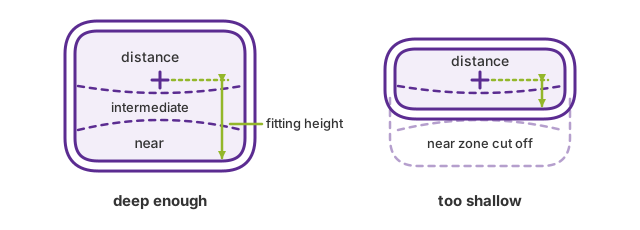
The distance zone fills the upper part of the lens. Below your pupil, a narrow channel carries the power smoothly down to the reading zone near the bottom, set slightly towards the nose because the eyes turn in to read. The areas on either side of the channel are softer in focus. Each design has a minimum fitting height, the distance from the centre of your pupil to the bottom edge of the lens, often somewhere between about 14 and 18 mm and set by the lens maker. Add the distance zone above the pupil, and most people need a frame about 30 mm deep or more.
Why shallow and steep frames cause trouble
- Slim fashion frames, such as narrow rectangles and small ovals under about 28 to 30 mm deep, leave too little lens below the pupil. The reading zone is cut off or squeezed, and you find yourself tipping your head back to read.
- Short-zone designs can fit some shallower frames, but the power changes over a shorter distance, so the middle and reading areas can feel narrower and adapting may take longer.
- Steep cat-eyes are often shallow in the middle, and their lower rim rises towards the outer corner, leaving little room for the middle and reading zones.
- Strongly wrapped frames tilt the lens around the face. A progressive lens then needs a special design, and some wraps cannot be fitted at all.
Frame styles for progressive lenses, one by one
Deep rectangle or soft square
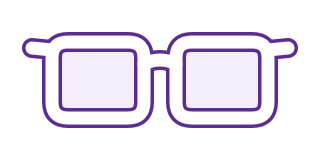
Wider than tall, or nearly square, with straight sides and softened corners, in a version deep enough for all three zones. It is an everyday office shape that no single designer is credited with.
- Advantages: room for all three zones and a wide reading area; suits office and daily wear; made in every material.
- Disadvantages: a deep, thick acetate version can look heavy; slim versions of the same shape are too shallow.
- Good for: first-time progressive wearers, office workers, most face shapes.
- Think twice if: you have a small, narrow face; look for a medium width that is still about 30 mm deep.
Navigator
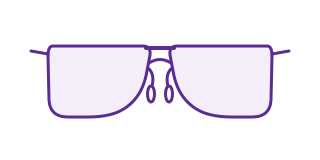
A squared-off aviator with a double bridge, from the 1950s; Vision Monday reported it returning in 2026 in place of shallow men's rectangles. Women wear it too.
- Advantages: deep lenses; adjustable nose pads let the fitter raise or lower the frame to set the height; light in metal.
- Disadvantages: large lenses make strong distance powers thicker and heavier; the double bridge can look busy on a small face.
- Good for: medium to broad faces, low to moderate powers.
- Think twice if: you have a narrow face or a high power.
Aviator
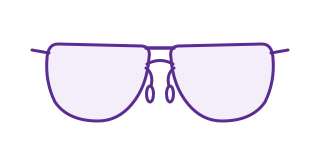
The teardrop pilot frame dates from the 1930s; its history is in frame shapes explained. Ray-Ban says the lenses dip low so that pilots could glance down at their instruments, which happens to leave room for a reading zone.
- Advantages: a deep lower part for the reading zone; adjustable pads; light.
- Disadvantages: a very large lens; the teardrop narrows towards the bottom, so the reading area is narrower than in a rectangle of the same depth.
- Good for: oval, square and heart-shaped faces; low to moderate powers; people who mostly need distance and middle vision.
- Think twice if: you have a high minus power, a small face, or you read for long hours at a stretch.
Panto, round and oval

A panto is round at the bottom with a flatter top; an oval is a gently stretched circle. Round wire frames were everyday wear in the 1920s and 1930s, and no single designer is credited with the panto or the oval.
- Advantages: current and soft-looking; medium sizes are often deep enough; the keyhole bridge of many pantos sits steadily.
- Disadvantages: the curved lower edge narrows the reading area; small wire rounds and small ovals are usually too shallow.
- Good for: most faces, in a size about 30 mm deep or more.
- Think twice if: the frame is a small round or oval, or you need a wide reading area for long desk work.
Cat-eye
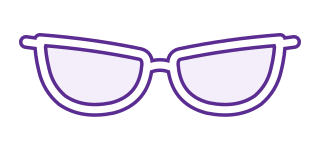
Upswept outer corners, a shape usually credited to the American designer Altina Schinasi in the late 1930s.
- Advantages: a soft cat-eye with good depth below the eye works well and keeps a feminine look.
- Disadvantages: steep, narrow cat-eyes cut into the middle and reading zones.
- Good for: women who want a cat-eye with progressives, in a soft, deep version.
- Think twice if: the wings are steep and the lens is shallow in the middle.
Half-rim and rimless
A half-rim holds the lower lens edge with a nylon cord; a rimless frame is fixed through holes drilled in the lenses. Who first made the half-rim is not well documented; the Austrian maker Silhouette and the Danish maker Lindberg are known for very light rimless designs.
- Advantages: light and discreet; a half-rim leaves the lower view open.
- Disadvantages: rimless needs tough lens materials and gentle handling; both show the lens edge; the lens depth still has to be enough.
- Good for: low powers, in a design with enough depth.
- Think twice if: you handle spectacles roughly or have a high power.
Nose pads and the right height
The fitting point of a progressive lens must sit exactly in front of your pupil. Metal frames with adjustable nose pads let the fitter raise or lower the frame by a millimetre or two and set its tilt, which is a real advantage. Plastic frames with a moulded bridge sit wherever the bridge puts them. If they slide down a low nose bridge, the reading zone slides with them, so a low-bridge fit or a frame with pads is safer.
Fitting height is measured with your chosen frame on
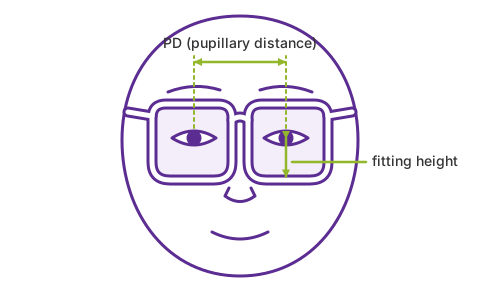
Measurements from an old frame, or a pupil distance alone, are not enough. With your new frame adjusted to sit as you will wear it, the fitter measures each eye separately:
- the distance from the centre of your nose to each pupil (monocular pupil distance);
- the fitting height, from the centre of each pupil to the bottom edge of the lens opening;
- for some lens designs, the frame's tilt, its wrap and its distance from your eyes.
If the frame is changed later, or bent out of shape, these numbers change too. This is the difference between handing over spectacles and dispensing them, explained in dispensing versus selling spectacles.
Getting used to the new lenses
- Wear them through the whole day for the first few days instead of switching back to an old pair.
- Face what you want to see; turn your head for side views rather than swinging your eyes.
- To read, keep your head level and lower your eyes.
- On steps and stairs, tilt your head down to look through the distance part, and hold the handrail.
Most people settle within a few days to two weeks. If you still feel dizzy, or a zone seems to be in the wrong place after about two weeks, the fitting, the frame adjustment and the power should be checked. Some people are more comfortable with separate reading glasses or with office lenses as a second pair; types of spectacle lenses explains these.
After cataract surgery
Many people need reading or progressive glasses after cataract surgery, once the eye doctor says the power has settled. A frame about 30 mm deep or more, with adjustable nose pads and in a light material, suits progressive lenses and is comfortable for long wear.
Dispensing, not just a label
With progressive lenses, the frame becomes part of the prescription. The eye test comes first, then a frame chosen around your powers, your measurements and how you work, then lenses made for that exact frame and fitted with it on your face. Fit and lenses matter far more than the label.
If you need spectacles, the Vision Correction Centre at ReNew Vision Eye Hospital, Vasco, provides vision correction: an eye test, lenses made to your prescription, and help choosing a frame that suits your lenses and your face.
Questions patients ask
What is the minimum frame height for progressive lenses?
It depends on the lens design. Most designs need roughly 14 to 18 mm of lens below the centre of the pupil, and with the distance zone above, a frame about 30 mm deep or more suits most people. The fitting height is measured with your chosen frame on your face.
Can I put progressive lenses in my old frame?
Often, if the frame is deep enough, in good condition and still fits well. The fitting height must be measured again with that frame adjusted on your face; numbers from your previous lenses cannot simply be copied. Very small, cracked or bent frames are better replaced.
Are aviator frames good for progressive lenses?
Often, yes. Aviators and navigators have deep lenses and adjustable nose pads that help set the height. Their large lenses can make strong distance powers thicker and heavier, and the teardrop aviator narrows towards the bottom, so the reading width needs checking.
Why do I tilt my head back to read with my new progressives?
Usually the reading zone sits too low, because the frame is too shallow, was fitted too low, or has slid down the nose. Adjusting the nose pads or bridge often helps; if not, the fitting height and the frame choice need to be rechecked.
Can I wear stylish frames with progressive lenses?
Yes. Many current shapes, such as navigators, deeper pantos, ovals, soft squares and soft cat-eyes, have enough depth. Be careful with slim, shallow fashion frames, steep cat-eyes and strongly wrapped sports frames.
Brand and model names on this page are trademarks of their owners and are used only to explain eyewear. ReNew Vision Eye Hospital is not connected with these brands.
This page is general eye-health information, not personal medical advice. Your eye doctor advises you after examining your eyes.