Home › Specialities › Vision correction › Eyewear guide
Spectacle frames and eyewear brands, explained
A good pair of spectacles is dispensed, not just sold: your prescription is turned into lenses placed accurately in a frame that suits your power, your face and your day. This guide explains frames, materials, brands and trends in plain words, with the advantages, disadvantages and lens effects of each, so you can choose with understanding.
Many people want to know about branded frames, designer frames and stylish spectacles, not only about lenses. For each frame shape, material, colour and brand it explains what it is, a little of its history, its advantages and disadvantages, who it suits, who should think twice, and what it means for your lenses. It does not recommend any brand, and it is not a catalogue.
Spectacles are dispensed, not just sold
One idea runs through every page of this guide. A prescription is a set of numbers. A pair of spectacles is those numbers placed accurately in front of your eyes, in a frame that fits your face and suits your power and your day. Turning one into the other is called dispensing: choosing a frame around the prescription, measuring your pupils and the fitting height in that frame, choosing lens materials and coatings, checking the finished lenses against the prescription, then fitting, adjusting and following up. A frame that is merely sold, without those steps, can look right and still give you headaches. The full explanation is in dispensing vs selling spectacles.
Why does the frame matter for your vision?
A frame is not only decoration. It does several optical jobs at once:
- It holds the optical centre of each lens in front of each pupil. If the centres are out of line, the lenses act like weak prisms and can cause strain or double images.
- It sets the distance and tilt of the lenses in front of your eyes, which matters for strong powers and for progressive lenses.
- Its size decides how thick and heavy your lenses will be. Minus lenses (for short sight) are thickest at the edges and plus lenses (for long sight and reading) in the centre, so large frames make strong lenses heavier.
- Its depth decides whether the reading zone of a progressive or bifocal lens fits.
- Its fit decides whether it stays put. Spectacles that slide down your nose move the lens zones away from your eyes.
- Its material affects comfort, skin reactions and how long it lasts in Goa's humid, salty air.
The parts of a frame
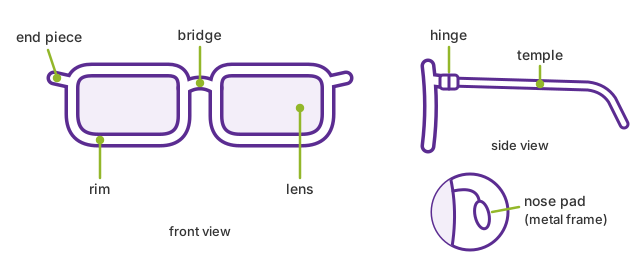
Every frame, plain or designer, is built from the same parts:
- Front and rims: the rims, also called eyewires, hold the lenses.
- Bridge: the part over your nose. Plastic frames usually have a moulded saddle or keyhole bridge; metal frames rest on adjustable nose pads mounted on small pad arms; aviators add a double bridge across the top.
- End pieces and hinges: the outer corners of the front, where the arms join. A simple barrel hinge only folds; a spring (flex) hinge lets the arm bend outwards, which helps with children and rough handling.
- Temples (arms) and tips: the arms run back over your ears, and the tips curve down behind them to hold the frame in place.
Many Indian adults and most children have a lower, flatter nose bridge. Moulded plastic bridges tend to slide down such noses, so frames with adjustable nose pads, or low-bridge-fit versions with taller nose rests, often sit better.
The three size numbers
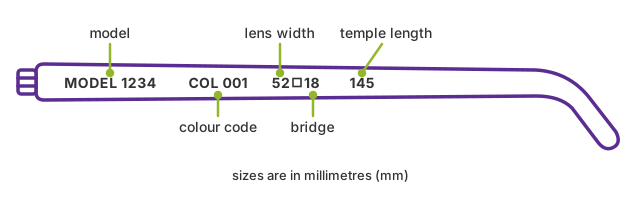
Inside one arm you will usually find a model number, a colour code and three size numbers, such as 52□18 145. They are in millimetres: 52 is the lens width (the eye size), 18 is the bridge, and 145 is the temple length. The small square stands for the boxing system, in which each lens is measured inside an imaginary rectangle drawn around it. Most adult frames have lenses about 50 to 54 mm wide and children's frames about 40 to 48 mm, and a bridge of 16 to 20 mm suits most adults. Two frames with the same numbers sit on the face in roughly the same way, whatever the brand or shape. One size that is not printed matters too: the lens height. Progressive and bifocal lenses usually need frames about 30 mm deep or more.
Frame shapes in brief
Fashion writers describe frames almost entirely by their outline: aviator and navigator; round, panto and oval; cat-eye, browline, oversized and geometric; rectangle, square and square-top; and the curved sport wrap. Rimless and half-rim describe how the lens is held rather than its outline. The traditional advice is contrast: angular frames balance a round face, and curved frames soften a square one. Every shape also changes your lenses: big and strongly curved frames make strong lenses thicker, and slim frames can be too shallow for progressives. Our page on spectacle frame shapes explained takes each shape in turn, with a drawing, a line of history, its advantages and drawbacks, and who should and should not choose it.
Frame materials in brief
- Acetate: a plastic made from cellulose (the fibre in cotton and wood pulp) mixed with a softener, cut from blocks or sheets, which gives deep colours and tortoiseshell patterns. It softens when warmed, so it can be adjusted. Bio-acetate uses a plant-based softener in place of the usual petroleum-based one.
- TR90 and other flexible nylons: very light and hard to break, which suits children and sport, but they spring back when warmed, so they are harder to adjust.
- Injected plastic: moulded into any shape and light, but it allows little adjustment and its paint can chip.
- Nickel alloys (monel, nickel silver): easy to shape, but the plating wears and nickel is one of the commonest causes of skin allergy.
- Stainless steel: strong even when thin; some grades contain no nickel.
- Titanium and beta-titanium: light, strong and rust-proof; pure titanium contains no nickel. Genuine titanium is usually stamped Titanium, Ti-P or β-Ti on the arm or bridge.
Piece for piece, TR90 weighs about as much as water, acetate a little more, and titanium a little over half as much as steel, which is why light frames almost disappear on the face. Compare them side by side in acetate, metal and titanium frames.
How does the eyewear brand world work?
Most famous eyewear names are not made by the fashion house on the label. A handful of eyewear companies design, make and distribute nearly all of them, either as brands they own or under licence. A licence means a fashion house lets an eyewear company design, make and sell glasses under its name for a fixed number of years. For example, EssilorLuxottica owns Ray-Ban, Oakley and Persol and makes Prada, Chanel and Burberry eyewear under licence; Kering Eyewear makes Gucci and Cartier eyewear and owns Lindberg; Safilo owns Carrera and Polaroid; Marcolin makes Tom Ford eyewear; and Thélios makes Dior eyewear.
Our page on Ray-Ban model codes explained uses one brand to show how model codes and sizes work.
What a brand name can tell you: who designed the look, and usually something about the materials and finish. What it cannot tell you: whether the frame fits your face, whether it suits your power, or whether the lenses in it are right. Spectacle lenses are made separately, to your prescription. More on this in eyewear brands explained.
Who decides what is in fashion?
Eyewear has its own fashion calendar. New collections are launched at a handful of trade fairs each year: opti in Munich in January, MIDO in Milan in February, Vision Expo in the United States in March, SILMO in Paris in September and the Hong Kong Optical Fair in November. Trade magazines such as 20/20, Vision Monday and VisionPlus report what launched. For 2026 they reported oversized fronts, pilot and navigator shapes, ovals and soft rounds, thin metal in colour and gold, chunky acetate, heavy brows, clear and crystal frames, colours such as plum, burgundy and teal, light tinted lenses and lighter smart glasses. A trend frame still has to suit your power and fit your face. See eyewear trends 2026.
Choosing for your face, colouring and power
- Face shape: the frame should be about as wide as your face at the temples, and its top line should roughly follow your eyebrows. See frames for your face shape.
- Colouring: frame colour can warm or cool your skin tone, and it works with your hair and eyes. See frame colour for your skin tone.
- High power: smaller, well-centred frames keep strong lenses thinner and lighter. See stylish frames for high power.
- Progressive lenses: the frame needs enough depth for the reading zone and a stable fit. See frames for progressive lenses.
Sunglasses: the lens protects, the frame styles
With sunglasses the same rules apply, plus one more: darkness is not protection. A clear lens can block all ultraviolet (UV) light and a very dark lens can block almost none. Behind a dark lens the pupil opens wider, so a dark lens without UV protection can let more UV into the eye. Look for UV400 lenses, which block UV light up to 400 nanometres. Polarised lenses cut reflected glare from water and wet roads, which many people find useful by the sea and on the road. More in power sunglasses.
All the pages in this guide
Eyewear trends 2026
Eyewear trends 2026 explained: oversized, navigators, clear and plum frames, tints, smart glasses. Pros, cons, who each suits and what it means for lenses.
Frames for your face shape
Find your face shape in a mirror, then see which frames usually suit round, oval, square, heart and long faces, and why fit and lens power come first.
Frame shapes explained
Types of spectacle frames explained: aviator, round, panto, cat-eye, browline, square, rimless and more, with pros, cons, who each suits and lens tips.
Frame materials
Acetate, bio-acetate, TR90, steel, monel, titanium, aluminium and wood frames: history, pros and cons, nickel allergy, and what suits Goa's humid air.
Frame colour and skin tone
Frame colour for Indian skin tones: find your warm or cool undertone, then see how black, tortoise, gold, silver, clear, plum and teal frames work.
Frames for men
Spectacle frames for men explained: navigator, browline, thin metal, rectangle, square-top, chunky acetate and rimless, with pros, cons and fit for work.
Frames for women
Spectacle frames for women explained: cat-eye, oval, oversized, clear, thin metal, panto and rimless, with pros, cons, low nose bridges, make-up, photos.
Eyewear brands explained
Eyewear brands explained: the few groups that make most designer frames, owned and licensed labels, Indian brands, and pros and cons of a branded frame.
Ray-Ban frames explained
Ray-Ban frames explained: the history, RB and RX codes, the numbers on the temple, and who the Aviator, Wayfarer, Clubmaster and Round each suit.
Original or fake glasses?
How to check original branded glasses and sunglasses: temple codes, lens etchings, finish, hinges, case and papers, the seller, the price, and a UV test.
Frames for high power
Stylish frames for high power: why smaller, centred, full-rim frames hide thick lenses, how high-index and aspheric lenses help, and which styles to avoid.
Frames for progressives
Frames for progressive lenses: minimum frame height, why shallow and steep cat-eye frames cause trouble, aviators, nose pads, fitting height and adapting.
Dispensing vs selling
What spectacle dispensing means: reading the prescription, PD and fitting height, frame tilt, lens checks on a lensmeter, fitting and aftercare.
Before you choose a frame
The sequence matters. The eye test comes first, because your prescription steers the choice of frame. Then the frame is chosen around your prescription, your measurements and the way you use your eyes, for driving, reading, screens or work. Only then are the lenses made, checked and fitted to your face. Fit and lenses matter more than the label: a frame you love but cannot see well through is not a good pair of spectacles.
If you need spectacles, the Vision Correction Centre at ReNew Vision Eye Hospital, Vasco, provides vision correction: an eye test, lenses made to your prescription, and help choosing a frame that suits your lenses and your face.
Questions patients ask
What does the small square between the frame numbers mean?
It stands for the boxing system. Each lens is measured inside an imaginary rectangle drawn around it, so the first number is the width of that box and the second is the gap between the two lenses at the bridge. The third number, the arm length, follows after a space or a dash.
Can any fashion frame take my prescription?
Most spectacle frames can, but there are limits. Single-lens shields cannot take a normal prescription, strongly curved wraps need special lens designs, very large frames make strong lenses thick and heavy, rimless frames show thick minus edges, and slim frames can be too shallow for progressive lenses.
Should I choose the frame before or after the eye test?
After. Your prescription steers the choice: strong powers do better in smaller, well-centred frames, and progressive lenses need enough frame depth. Choosing first can mean falling for a frame that does not suit your lenses.
How often do eyewear fashions change?
New collections are launched at trade fairs every year, and trade magazines report the new looks each season. Classic shapes such as aviators, square-tops, browlines and rounds have lasted for decades, so a well-chosen frame need not date quickly.
Brand and model names on this page are trademarks of their owners and are used only to explain eyewear. ReNew Vision Eye Hospital is not connected with these brands.
This page is general eye-health information, not personal medical advice. Your eye doctor advises you after examining your eyes.