
Home › Specialities › Vision correction › Eyewear guide › Original or fake glasses?
How can I check if my branded glasses are original?
Check several clues together: sharp codes inside the arms that match the box and bill, neat etching on sunglass lenses, an even finish, solid hinges, papers, and a seller the brand lists as authorised. A price far below the brand's own listed price is a reason to check more carefully. For sunglasses, a UV test matters most.
Famous eyewear names are copied widely, from spectacle frames to sunglasses. A copy frame mostly costs you comfort and durability, but copy sunglasses can also harm your eyes if their dark lenses do not block ultraviolet (UV) light. No single mark proves that a piece is genuine, because markings can be copied too, so look at several clues together.
Why it matters for your eyes
- Missing UV protection: a dark lens makes the pupil open wider. If the lens does not block UV, it can let more UV reach the inside of the eye than wearing no sunglasses at all. Over years, UV exposure is linked with cataract and pterygium, and strong sun off water or sand can burn the surface of the eye within hours. See power sunglasses in Goa.
- Distorted lenses: poorly made lenses can have waves in them that blur the view and tire the eyes.
- Skin allergy: low-grade plated metal often contains nickel, a common cause of itching and of dark or green marks on the nose and behind the ears.
- Weak hinges and soft frames: a frame that bends out of shape no longer holds prescription lenses centred in front of your eyes.
Check 1: the markings inside the arms
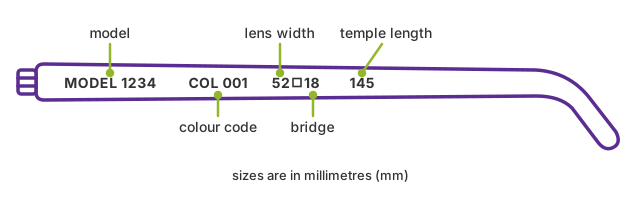
Branded frames carry printed codes inside the arms: usually the model number, the colour code and the size, for example 52□18 145 (lens width, bridge and arm length in millimetres). The other arm usually carries the logo, the country of manufacture and the CE mark, a European conformity mark.
- The print should be sharp, straight and evenly spaced, not blurred or crooked.
- The codes should match the label on the box and the model written on the bill.
- Titanium frames are usually stamped "Titanium", "Ti-P" or "β-Ti". Unmarked "titanium" may be plated metal; our guide to frame materials explains the difference.
- Limit of this check: copies often print real-looking codes, so correct numbers are a good sign, not proof.
Check 2: logos on sunglass lenses
Many brands mark their sunglass lenses permanently. Ray-Ban, for example, laser-etches a tiny "RB" near the hinge on the left lens and puts its script logo on the right lens, with a "P" beside it on polarised lenses. The etched "RB" is faint but does not rub off with normal cleaning, so look for it in good light; a missing, crude or printed-on "RB" is a warning sign. A worn logo on an old pair proves nothing by itself. Prescription lenses fitted later carry no brand etching unless the brand made them. Other brands use their own marks, and the brand's own website usually explains them. Our page on Ray-Ban frames explained shows how one brand's codes work.
Check 3: finish, hinges and weight
- Finish: good acetate is cut from layered sheets and polished, so its colours and patterns run through the material. Colour sprayed onto the surface that chips at the edges suggests moulded plastic, which many genuine models also use; it tells you the material, not whether the frame is genuine.
- Edges and joins: look for rough seams, mould lines, glue marks or gaps where the lens meets the rim.
- Hinges: they should open and close smoothly and evenly, with screws that sit flush. Some brands put a small logo on metal nose pads.
- Symmetry: placed upside down on a flat table, both arms of a well-made frame touch it evenly.
- Weight: classic glass sunglass lenses feel heavy and cool to the touch, but many genuine models use light nylon or polycarbonate lenses, so weight alone proves nothing. Compare with the brand's own description of that model.
Check 4: the case and the papers
- A genuine piece usually comes with the brand's case, a cleaning cloth and a booklet or warranty card. Boxes and cases are copied too, so they support the other checks rather than replace them.
- Ask for a proper bill showing the seller's name and address, the GST number, and the brand, model number and colour code.
- Keep the bill and the warranty card together; you will usually need both for a warranty claim.
Check 5: where it came from, and the price
Where a pair comes from is a useful clue. Whoever you buy from, check on the brand's own website that the seller is listed as authorised, ask for a GST bill showing the brand, model number and colour code, and keep the warranty card. Take extra care if the seller could not be traced later or the UV protection cannot be checked. A pair bought abroad or second-hand may be genuine but may not carry the brand's Indian warranty.
The price: a price far below what the brand's own website shows for that model is a reason to check the other clues more carefully.
Check 6: ask for a UV test
For sunglasses, this is the check that protects your eyes.
- What the label means: UV400 means the lens blocks ultraviolet light up to 400 nanometres, which covers both UVA and UVB. A label can be printed on anything, so it is not proof by itself.
- The test: a UV meter is a small instrument that measures, in a few seconds, how much UV passes through a lens. An optician with a UV meter can check your sunglasses before you rely on them.
- Darkness is not protection: a clear lens can block all UV, and a very dark lens can block almost none. Very dark category 4 lenses are meant for snow and glaciers and are unsafe for driving.
- Polarised or not: hold two polarised lenses one in front of the other and turn one by 90 degrees; if both are polarised, the overlap goes almost black. Polarisation cuts glare, but it is separate from UV protection.
- Distortion: look through the lens at a straight edge, such as a window frame, and slowly move the sunglasses up, down and sideways. A good lens keeps the edge straight; a wavy lens makes it bend or swim.
What about prescription lenses?
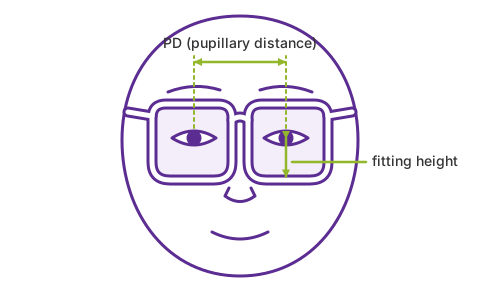
For spectacles, the lenses matter more than the label on the frame. Their power can be checked on a lensmeter (focimeter) against your prescription, and their optical centres should line up with your pupils.
If you think you have a copy
- Do not rely on untested dark sunglasses for long hours in strong sun until a UV test has shown that they block UV.
- If a metal frame gives you itching or marks, stop wearing it; frames that are pure titanium in every part, or acetate, usually suit sensitive skin better; with steel, ask which grade it is.
- If your eyes become red, painful or watery after a day in the sun, or your vision changes, see an eye doctor.
Before you choose a frame
Checking that a frame is genuine tells you about the frame only. For your vision, the eye test comes first; then the frame is chosen around your prescription, measurements and daily use, and the lenses are checked on a lensmeter and centred on your pupils, as explained in dispensing versus selling spectacles. Fit and lenses matter more than the label. For how brands are made and named, see eyewear brands explained, and for shapes, materials and trends, the eyewear guide.
If you need spectacles, the Vision Correction Centre at ReNew Vision Eye Hospital, Vasco, provides vision correction: an eye test, lenses made to your prescription, and help choosing a frame that suits your lenses and your face.
Questions patients ask
Can fake sunglasses damage my eyes?
They can, if the dark lenses do not block UV. Behind a dark lens the pupil opens wider, so a lens without a UV filter can let more UV reach the inside of the eye than wearing no sunglasses at all. Over years, UV is linked with cataract and pterygium. A UV test settles the question.
Does Made in China mean my branded frame is a fake?
No. Large eyewear brands make frames in several countries, including China, Japan, India and Italy, and print the country inside the arm. The country alone does not tell you either way; check the markings, finish, papers and seller together.
Is a frame with the correct model number always genuine?
No. Copies often print real model numbers. Sharp codes that match the box and the bill are a good sign, but they are only one clue among several.
Are polarised lenses the same as UV-protected lenses?
No. Polarisation cuts glare reflected from water and roads, while UV protection blocks invisible ultraviolet light. A lens can have one without the other, so check both.
What should the bill for branded glasses show?
The seller's name and address, the GST number, the date, and the brand, model number and colour code of the frame. Keep it with the warranty card.
Brand and model names on this page are trademarks of their owners and are used only to explain eyewear. ReNew Vision Eye Hospital is not connected with these brands.
This page is general eye-health information, not personal medical advice. Your eye doctor advises you after examining your eyes.