Home › Specialities › Vision correction › Eyewear guide › Ray-Ban frames explained
Ray-Ban frames: what do the models and numbers mean?
Ray-Ban began in 1937, when Bausch & Lomb made anti-glare sunglasses for American pilots; Luxottica has owned it since 1999. Its range is grouped into families such as Aviator, Wayfarer, Clubmaster and Round. Codes starting RB are sunglasses and RX are spectacle frames. Each family suits different faces, powers and lens types.
"Ray-Ban power glasses" is a common search. This page explains where the brand came from, how its range is organised, how to read the numbers printed on the frame, and the strengths and weaknesses of each main family for people who need prescription lenses. Ray-Ban is a trademark of its owner; ReNew Vision Eye Hospital is not connected with the brand, and this page does not recommend any model.
A short history
- 1936 to 1937: the American optical company Bausch & Lomb developed anti-glare sunglasses for US Army Air Corps pilots. After a prototype in 1936 they went on sale in 1937 as Ray-Ban, a name that refers to banning the sun's rays.
- The Aviator: Ray-Ban says the teardrop lenses dip low so that pilots could glance down at their instruments. The green-grey G-15 lens tint was first made for the military; the 15 is usually explained as letting through about 15% of light.
- 1952: the Wayfarer, designed by Raymond Stegeman at Bausch & Lomb, brought a thick plastic, trapezoid shape.
- 1950s: the Caravan, a squared-off aviator with a double bridge.
- 1986: the Clubmaster, a browline with a 1950s look.
- 1989: the Round Metal, the year Ray-Ban gives for its round wire frame.
- 1999: Bausch & Lomb sold Ray-Ban to the Italian company Luxottica, which became part of EssilorLuxottica in 2018. Our page on how eyewear brands work explains these groups.
How the range is organised
Ray-Ban groups its eyewear into families of shapes. Each family has an original model with variations around it: newer versions, all-metal versions, lighter materials and several sizes. The letters at the start of the model number tell you what kind of product it is.
- RB: sunglasses.
- RX: optical frames, made to take prescription lenses.
- RJ and RY: junior sunglasses and junior optical frames for children.
- RW: Ray-Ban Meta smart glasses, with a built-in camera and speakers.
- RBR: the Reverse line (2023), with an inverted lens curve.
- F at the end (for example RB2140F): a Low Bridge Fit version with taller nose rests, for flatter nose bridges and higher cheekbones. Many Indian faces need this kind of fit.
Optical (RX) frames come with plain demonstration lenses. Your prescription lenses are made separately and fitted into the frame, so the frame brand and the lenses are two different choices.
How to read the numbers on the temple
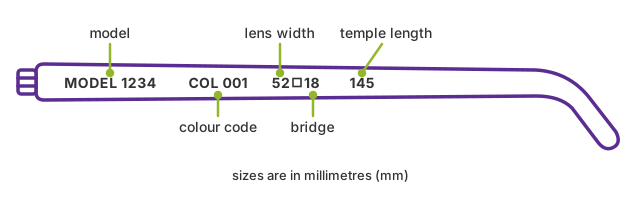
Inside the left arm of a typical Ray-Ban sunglass you may find a line such as RB3025 001/58 58□14 135 3P:
- RB3025: the model number (here, the Aviator Classic).
- 001/58: the colour code; 001 is the frame colour (gold) and 58 the lens (green, polarised).
- 58□14: lens width and bridge width in millimetres. The box sign stands for the boxing system, in which each lens is measured inside an imaginary box.
- 135: arm (temple) length in millimetres.
- 3P: lens category 3 (dark), P for polarised.
On RX spectacle frames the line is similar but has no lens category, because the demonstration lenses will be replaced. The other arm carries the logo, the country of manufacture and the CE mark. Many models come in several sizes (the Aviator sunglass in 55, 58 and 62 mm, for example), so note the size numbers of a frame that fits you well.
The main families, one by one
The face-shape notes below follow the usual contrast rule, which is only a starting point; frame shapes explained covers every shape.
Aviator
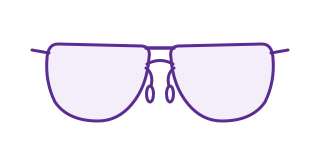
Thin metal, a double bridge and large teardrop lenses, from the 1937 pilot sunglass. The Aviator Classic sunglass is RB3025; spectacle versions carry RX codes. The Caravan is its squared-off cousin from the 1950s.
- Advantages: light; adjustable nose pads fit flatter and narrower noses; the deep lower part leaves room for the reading zone of a progressive lens.
- Disadvantages: large lenses make a high minus power thick at the edges and a high plus power heavy; the double bridge is a strong look.
- Good for: oval, square and heart-shaped faces (the squarer Caravan also suits round faces); low to moderate powers.
- Think twice if: your power is high; the smallest size, or a smaller family, keeps the lenses thinner.
Wayfarer

Thick plastic and a trapezoid outline, wider above than below, with upswept outer corners; designed in 1952. The family includes sunglasses and acetate spectacle frames, and the New Wayfarer and Wayfarer Ease are smaller, softer or lighter variations. Wayfarer is Ray-Ban's trademark; similar frames from other makers are simply called trapezoid frames.
- Advantages: the thick full rim hides the edges of minus lenses well; sturdy.
- Disadvantages: heavier than metal; the moulded nose rest cannot be adjusted much, so on a flat nose bridge the standard version can slide down or touch the cheeks.
- Good for: round and oval faces, men and women; short-sight (minus) powers.
- Think twice if: you have a low nose bridge (Low Bridge Fit versions, marked F, have taller nose rests) or you want a very light frame.
Clubmaster
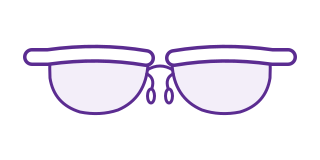
A browline: a heavy plastic brow along the upper edge and thin metal rims below, launched in 1986 with a 1950s look.
- Advantages: the brow follows the eyebrows and hides the upper lens edge; the metal nose pads can be adjusted.
- Disadvantages: the lower lens edge shows through the thin metal rim, so a thick minus edge is more visible at the bottom; the bold brow is not to everyone's taste.
- Good for: oval, round and heart-shaped faces; office and everyday wear.
- Think twice if: you prefer a light, quiet look, or your eyebrows sit well above where the brow would rest.
Round
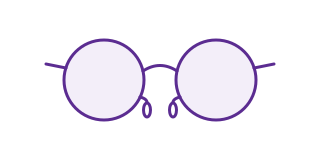
Circular lenses on a thin metal wire, in a style inspired by the 1960s; Ray-Ban dates its Round Metal to 1989. Panto shapes, round with a flatter upper edge, are close relatives.
- Advantages: small round lenses keep high powers thinner and lighter, as long as your eyes sit near the centre of each lens; very light.
- Disadvantages: can look small on a wide face; small sizes may be too shallow for the reading zone of a progressive lens.
- Good for: square and angular faces and strong jawlines; higher powers.
- Think twice if: you have a round, full face, or you need progressive lenses in a small size.
Everyday rectangle and square
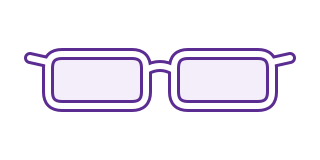
The office frame, in acetate, light injected plastic or thin metal; an everyday shape credited to no single designer.
- Advantages: practical, moderate sizes and a quiet look for work.
- Disadvantages: slim, shallow rectangles can cut off the reading part of a progressive or bifocal lens.
- Good for: round and oval faces; daily office wear.
- Think twice if: you need progressives and the lens is shallow; about 30 mm of lens depth is a common guide.
Larger shapes, other styles and titanium
Larger sunglass shapes shade more of the eye area, but with a strong prescription large lenses become thick and heavy. Ray-Ban's range is built mainly around the families above; cat-eye, rimless and half-rim styles are a small part of it. It also has a line of Japanese-made titanium frames, which are very light and resist corrosion in salty air.
Ray-Ban power glasses: what to know
- The prescription lenses, not the frame, correct your vision. Their power, centring, material and coatings are chosen after your eye test.
- Many of the flatter sunglass frames can take prescription tinted or polarised lenses. Strongly curved fronts need special lens designs, and some powers cannot be fitted well; your eye doctor or optometrist advises after the eye test.
- For progressive lenses, the model must be deep enough for the reading zone; see frames for progressive lenses.
- For high powers, a smaller size with your eyes near the centre of each lens keeps the edges thinner; see stylish frames for high power.
Ray-Ban frames overall
- Advantages: long-running shapes with consistent sizing, several sizes per model, Low Bridge Fit versions, clear markings, and acetate, metal and titanium options.
- Disadvantages: part of what you pay goes to the name; the brand is widely copied, so checking that a piece is genuine matters; few rimless, half-rim or cat-eye choices.
- Good for: people who like these particular classic shapes and want a traceable branded frame.
- Think twice if: you want the name more than the shape; a frame that suits your face and your power matters more.
Is it genuine?
On genuine Ray-Ban sunglasses a tiny "RB" is etched on the left lens, and the script logo sits on the right lens, with a "P" added on polarised lenses. "Made in Italy" is not the only genuine origin: the brand's own range includes models made in India, China and Japan. Our guide on how to check if branded glasses are original covers markings, finish, papers and UV testing.
Before you choose a frame
Choosing within any brand works the same way. After the eye test, the family and size are chosen around your power (smaller for high powers), the depth your lenses need (enough for a progressive lens's fitting height) and your nose bridge; then the lenses are made, centred and checked for that frame. Fit and lenses matter more than the label. Our page on dispensing versus selling spectacles explains how a frame and lenses are measured, fitted and checked.
If you need spectacles, the Vision Correction Centre at ReNew Vision Eye Hospital, Vasco, provides vision correction: an eye test, lenses made to your prescription, and help choosing a frame that suits your lenses and your face.
Questions patients ask
What does RX mean on Ray-Ban glasses?
RX marks an optical frame, made to take prescription lenses. RB marks sunglasses, and RY or RJ marks children's models. The four digits that follow identify the model.
Can Ray-Ban sunglasses be made with my power?
Often, especially the flatter shapes. Strongly curved fronts need special lens designs, and very high powers may not suit large or wrap frames. Your eye doctor or optometrist advises after the eye test and after looking at the frame.
What does the letter F mean in a Ray-Ban model number?
It marks a Low Bridge Fit version, with taller nose rests for flatter nose bridges and higher cheekbones. These versions help when standard plastic frames slide down the nose or touch the cheeks.
Which Ray-Ban size should I choose?
The first two size numbers inside the arm are the lens width and the bridge in millimetres. Your eyes should sit near the centre of each lens and the frame should be about as wide as your face. Higher powers usually look and feel better in a smaller size.
Are India-made Ray-Ban glasses genuine?
They can be. The brand makes some models in India and others in China, Japan and Italy. The country printed on the arm does not by itself tell you whether a piece is genuine; check the markings, papers and seller together.
Brand and model names on this page are trademarks of their owners and are used only to explain eyewear. ReNew Vision Eye Hospital is not connected with these brands.
This page is general eye-health information, not personal medical advice. Your eye doctor advises you after examining your eyes.