Home › Specialities › Vision correction › Eyewear guide › Frames for women
Which spectacle frame styles suit women?
Cat-eye, oval, oversized, clear, thin coloured metal, panto and rimless frames each suit some women and not others. Choose fit first: the bridge should sit on your nose without sliding or resting on your cheeks, your pupils should be near the lens centres, and the frame must suit your power and, after 40, a progressive lens.
Women's frames come in the widest range of shapes, colours and details, which makes choosing enjoyable and also easy to get wrong. A frame that looks lovely in a photo can slide down a low nose bridge, rest on your cheeks when you smile, or be too shallow for the progressive lenses many women need after 40. This guide explains the main styles, where they came from and who each suits. Face shape is only one part of the choice; see frames for your face shape, frame colour for your skin tone for colour, and eyewear trends 2026 for what trade magazines reported this year.
The main styles, one by one
Cat-eye

The outer upper corners sweep upwards and lift the face. The American artist Altina Schinasi is usually credited with designing the upswept 'Harlequin' frame in the late 1930s, and the shape became the glamour look of the 1950s.
- Advantages: lifts and widens the eye area; flatters round and heart-shaped faces; works from subtle to dramatic.
- Disadvantages: steep, narrow cat-eyes are often too shallow for progressive lenses; sharp wings can look severe on an angular face; the long outer corner is the thickest part of a strong minus lens.
- Good for: round, oval and heart-shaped faces; single-vision wearers; women who like a feminine, vintage look.
- Think twice if: you wear progressive lenses (choose a soft cat-eye with enough depth below the eye), or you have a very angular face or a high minus power.
Oval

A gentle, slightly wide ellipse with no corners: quiet and classic. No single designer is credited with it.
- Advantages: soft and easy to wear; balances square and angular faces; looks right at work and at home.
- Disadvantages: small ovals can be too shallow for progressive lenses; on a very round face the curves can add roundness.
- Good for: square, angular and long faces; women who want a frame that does not dominate.
- Think twice if: you have a very round face, or you need progressive lenses and the oval is small (check the depth).
Oversized

Large fronts and lenses, in spectacles as well as sunglasses. Very large frames were a strong look of the 1970s and 1980s; no single designer is credited.
- Advantages: bold; a wide field of view; plenty of depth for progressive lenses.
- Disadvantages: large lenses become thick and heavy with any strong power; the frame may rest on the cheeks and slide; on a narrow face the pupils sit far from the lens centres.
- Good for: broad faces, low powers, progressive wearers who want a fashion frame with depth.
- Think twice if: you have a narrow face, a low nose bridge, or a high power, minus or plus.
Clear and crystal frames
Transparent acetate or plastic, plain or lightly tinted in smoke grey, pale tea, soft rose or olive; no single designer is credited. Many girls and young women like transparent frames because they look light and modern.
- Advantages: go with any skin tone and outfit; make a thick frame look lighter; suit school, college and office.
- Disadvantages: show dust, make-up and skin oil; some clear plastics turn yellowish with age and sun; the lens edge shows through the frame.
- Good for: teenagers and young women; women who want a frame that is noticed less.
- Think twice if: you have a high minus power and want to hide the edge (a coloured or tortoise acetate hides it better).
For school-age girls, fit comes before fashion: a light, flexible material such as TR90 or soft acetate, spring hinges, and a bridge that sits on a small nose without sliding. The parents' guide to children's spectacles has more.
Thin coloured metal

Fine metal frames in gold, rose gold or soft colours, often round, oval or geometric (hexagon or octagon). Wire frames were everyday spectacles long before plastics; no single designer is credited.
- Advantages: light and delicate; adjustable nose pads fit almost any nose, including a low bridge.
- Disadvantages: can bend; plated nickel alloys can corrode, lose colour and cause skin allergy; thin rims show the edge of a strong lens.
- Good for: narrow and small faces, low nose bridges, women who want a delicate look, low to moderate powers.
- Think twice if: you have a nickel allergy (choose a frame that is pure titanium in every part, not memory titanium, or plastic; if earrings give you a rash, say so at the fitting) or a high minus power.
Panto

Round with a flattened upper edge, often with a keyhole bridge; opticians also call it P3, and no single designer is credited. It is softer and easier to wear than a full circle.
- Advantages: suits most faces; looks current in metal and acetate; a keyhole bridge rests on the sides of the nose rather than its ridge.
- Disadvantages: the rounded lower half narrows the reading area of a progressive lens if the frame is small; acetate keyhole bridges allow little adjustment.
- Good for: most face shapes, women who want a gentle vintage look, higher powers in a modest size.
- Think twice if: you need progressive lenses and the frame is small or shallow.
Rimless
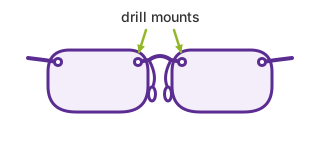
The lenses are drilled and screwed to the bridge and arms, with no rim. Silhouette of Austria is one maker known for very light rimless frames.
- Advantages: the lightest style; almost invisible; leaves your features and make-up on show; suits most faces.
- Disadvantages: fragile; screws can loosen; needs a tough, drill-friendly lens material, such as Trivex, polycarbonate or a suitable high-index plastic (glass cannot be used); the lens edge is fully visible.
- Good for: low to moderate powers, office and formal settings, women who want spectacles to disappear.
- Think twice if: you have a high power, small children who grab spectacles, or you tend to be rough with them.
Jewellery details and chains
Crystals, pearls, decorative arms, chrome finishes and spectacle chains, which 20/20 magazine reported as a 2026 trend. Fashion houses bring jewellery ideas to frames; Chanel, for example, is known for pearl and chain details on its frame arms. A chain or cord is also practical: reading glasses hang ready instead of being misplaced.
- Advantages: turns spectacles into an accessory; a chain keeps reading glasses at hand.
- Disadvantages: decorations add weight, catch on hair and dupattas, and can tarnish in humid air; a heavy chain pulls the frame down and loosens the arms.
- Good for: functions and occasions; women who take reading glasses on and off all day.
- Think twice if: you need one sturdy pair for everything every day, or you have a metal allergy.
Narrow faces and low nose bridges
A lower, flatter nose bridge is common in many Indian adults. On such a nose, a plastic frame with a moulded bridge slides down, or rests on the cheeks and lifts when you smile, which also smudges make-up and fogs the lenses.
- Adjustable nose pads on metal frames can be bent to fit almost any nose and set the frame at the right height.
- Low-bridge fit (also called Asian fit) plastic frames have taller nose rests that lift the frame off the cheeks. Some brands mark these versions in the model code; Ray-Ban, for example, adds an F to the end of its Low Bridge Fit model numbers.
- Narrow faces usually need smaller lens widths, around 46 to 50 mm, and shorter arms. A frame that is too wide leaves your pupils near the inner edge of each lens and slides off.
Make-up and lenses
- Check that your eyelashes do not brush the lenses; long lashes and mascara leave smears, and the frame may need to sit a little further from the eye.
- Let face cream, sunscreen and foundation settle before putting spectacles on. Clean lenses with water and a little mild soap, not make-up remover or nail-polish remover, which can leave a film or damage coatings.
- With reading glasses or plus lenses, eye make-up is hard to apply because you cannot see clearly without them; a magnifying make-up mirror helps.
- Strong minus lenses make eyes look smaller and strong plus lenses make them look larger; aspheric and high-index lenses reduce this a little, mostly with plus lenses. The guide to spectacle lenses explains lens types.
Weddings, functions and photos
- An anti-reflection coating reduces the white flashes from camera flashes, video lights and stage lights, so your eyes show in photos and videos.
- Photochromic lenses darken in outdoor sunlight, so in daytime outdoor photos they can look like sunglasses. Clear lenses with anti-reflection photograph better.
- If the frame rests on your cheeks, bridal or party make-up will smudge; a frame with nose pads or a low-bridge fit avoids this.
- Lowering the chin slightly helps the photographer avoid glare on the lenses.
After 40: progressive lenses and fashion frames
Most women need help with reading from their 40s. Progressive lenses need a frame about 30 mm deep or more, so that the reading zone is not cut off; slim fashion frames and steep cat-eyes are the usual problem. Frames for progressive lenses shows which styles work.
Dispensing, not just a label
However much you love a frame, the steps that make it work stay the same: an eye test first, then a frame chosen around your prescription, your face measurements and your day, then lenses made for that frame and fitted with care. Fit and lenses decide how well you see and how comfortable you are; the label decides neither.
If you need spectacles, the Vision Correction Centre at ReNew Vision Eye Hospital, Vasco, provides vision correction: an eye test, lenses made to your prescription, and help choosing a frame that suits your lenses and your face.
Questions patients ask
Do cat-eye frames work with progressive lenses?
Soft cat-eyes with enough depth below the eye usually do. Steep, narrow cat-eyes are often too shallow, and their lower rim rises towards the outer corner, leaving little room for the middle and reading zones. The depth is checked with the frame on your face before the lenses are made.
Why do my spectacles rest on my cheeks?
Usually the nose rest is too low for your nose bridge, so the frame sits down on the cheeks and lifts when you smile. A metal frame with adjustable nose pads, or a low-bridge fit plastic frame with taller nose rests, lifts it clear.
Are transparent frames a good choice for girls?
Often, yes. Clear frames look light and go with every outfit and skin tone. For school-age girls, choose a flexible material and spring hinges, and check that the bridge sits on a small nose without sliding. Clear frames show dust and make-up, so they need cleaning often.
How do I stop my glasses reflecting in wedding photos?
An anti-reflection coating on the lenses reduces reflections from flash and video lights, and lowering your chin slightly also helps. Avoid photochromic lenses for outdoor daytime photos, since they darken in sunlight.
How can I tell if an oversized frame is too big for me?
Check three things in the mirror. Your pupils should sit near the centre of each lens, not near its inner edge; the frame should be no wider than your face at the temples; and when you smile, the rims should not press on your cheeks or smudge your make-up. If they do, a smaller size, adjustable nose pads or a low-bridge fit usually helps.
Can I wear a spectacle chain with any frame?
Most frames can take a chain or cord on the arms. A light chain is fine; a heavy one pulls the frame down and can loosen the arms over time. For reading glasses that come on and off all day, a chain is practical.
Brand and model names on this page are trademarks of their owners and are used only to explain eyewear. ReNew Vision Eye Hospital is not connected with these brands.
This page is general eye-health information, not personal medical advice. Your eye doctor advises you after examining your eyes.